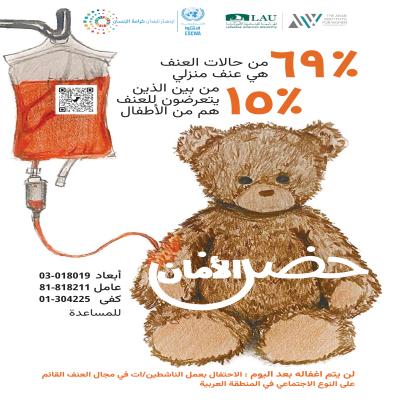
On the occasion of the 16 Days of Activism against Gender-Based Violence, the Institute for Women’s Studies in the Arab World (IWSAW) and the Student Affairs at the Lebanese American University with the collaboration of KAFA organized a Clothesline Exhibit on December 4, 2007. The exhibit included a visual display of shirts with a graphic messages and illustrations that have been designed by women survivors of violence or by friends of women victims. The purpose of this exhibit was to increase awareness among LAU students of the impact of violence against women. As part of the event, a lecture on “Violence against Women” was held by Attorney at Law, Danielle Hoyek.
LAU students during the exhibition
During the lecture
Front row: left to right: Dr. Dima Dabbous-Sensenig and Dr. Leila Nimah
The Institute for Women’s Studies in the Arab World (IWSAW) and the Danish Center for Information on Women and Gender (KVINFO) held a conference entitled: “The Status of Gender Research in Denmark and the Arab Region”. This conference was organized in the context of the regional programme Dialogue and Cooperation on Women’s Rights in the Arab Region, financed by the Danish Ministry of Foreign Affairs. This programme is specifically focusing on four strategic areas identified through consultation with Arab civil society: legal change, women in the public sphere, domestic violence, and research, documentation and information on gender-related issues.
28 researchers and experts from different Arab countries (Tunisia, Morocco, Syria, Yemen, Palestine, Jordan, and Lebanon) and European countries (Denmark and United Kingdom) convened for two and a half days to discuss the status of gender research in Denmark and the Arab region.

Group photo
From left to right: Dr. Mahmoud Issa,
Dr. Abdallah Sfeir, & Dr. Dima Dabbous-
Sensenig
On the occasion of the International Women’s Day 2008, the Institute for Women’s Studies in the Arab World (IWSAW) at the Lebanese American University, in partnership with the British Council of Lebanon dedicated this day to the memory of a very special Lebanese woman, the late Mai Ghoussoub. During the tribute, friends, family, and guests remembered Mai’s significant achievements and qualities.
Speakers at the tribute were: Dr. Joseph Jabbra, President of the Lebanese American University; Ms. Maud Stephan, representative of H.E. Dr. Tarek Mitri, Minister of Culture; Mr. Cris O’Connor, representative of H.E. Frances Guy, Ambassador of the United Kingdom; Ms. Amanda Burrell, Director of the British Council in Lebanon; Dr. Dima Dabbous-Sensenig, IWSAW Director; Dr. Maggie Gee, novelist and visiting professor of creative writing at Sheffield Hallam University, UK; Mr. Abbas Beydoun, Lebanese poet; and Dr. Roseanne Saad Khalaf, Assistant Professor of English and creative writing at the American University of Beirut.
The tribute was followed by an exhibit of Mai’s work and personal effects.
Dr. Joseph Jabbra
The Audience

Dr. Dima Dabbous-Sensenig
The Institute for Women’s Studies in the Arab World (IWSAW) at the Lebanese American University and the Graduate Program in Comparative Literature in partnership with the British Council in Beirut hosted Dr. Maggie Gee, novelist, short story-writer and critic, Chair of the Royal Society of Literature, Visiting Professor of Creative Writing at Sheffield Hallam University. Dr. Gee’s lecture was entitled:“How Can Art Help With Reconciliation?”
From left to right: Dr. Maggie Gee & Dr. Dabbous-Sensenig
The Institute for Women’s Studies in the Arab World at the Lebanese American University conducted on November 2, 2007 a training session on the use and implementation of the Basic Living Skills Program. The attendants were 12 participants who work as social workers in the different branches of the Lebanese Women Democratic Gathering. The training session was conducted by Ms. Anita Nassar (Assistant Director & Program Officer-IWSAW).
Marking International Women’s Day, the Institute for Women’s Studies in the Arab World honored a group of brave, dedicated, unflinching and highly motivated Lebanese war correspondents on March 2, 2007. Mona Saliba (LBCI), Rima Maktabi (Al-Arabiya/MBC Group), Manar Sabbagh (Al-Manar TV), Nancy Sabeh (NewTV), Diana Mukalled (Future TV), Samia Nakhoul (Reuters), Nada Abdelsamad (BBC Arabic Service) and Boushra Abdel Samad (Al-Jazeera) spoke about their experiences and received honorific awards from LAU. These women have demonstrated competence and professionalism in reporting day-to-day war developments locally and internationally, even at the risk of losing their lives.
The honored reporters with IWSAW Director Dima Dabbous-Sensenig, LAU President Joseph Jabbra, and HE Ghazi Al-Aridi, Minister of Information. The entire group, from left: Samia Nakhoul, Diana Mukalled, Nada Abdelsamad, Dima Dabbous-Sensenig, Joseph Jabbra, Ghazi Aridi, Nancy Sabeh, Manar Sabbagh, Rima Maktabi, Mona Saliba, Boushra Abdel Samad.
Trainees at work with Ms. Anita Nassar (second from left) and Mr. Mohammad Hajjar
Training on the use and implementation of a new literacy program for adult women was offered to 97 teachers from various areas of Lebanon in February 2007. The sessions were organized by the Institute for Women’s Studies in the Arab World in cooperation with the Ministry of Social Affairs’ National Committee for Literacy and Adult Education.
The program, entitled “Empowering Arab Women Through Literacy” (EAWTL), was created based on the needs of adult Lebanese women and launched by the Institute in 2006.
Participants from various non-governmental organizations and from the Centers for Training and Social Services and Development (of the Ministry of Social Affairs) participated in the five one-day workshops corresponding to their geographical areas. Two sessions took place in Beirut (for Beirut, Greater Beirut and North Lebanon), two in Baalbeck (for the Bekaa area) and one in Nabatiyeh (for South Lebanon).
The trainers were Ms. Anita Nassar, IWSAW’s assistant director and program coordinator, and Mr. Mohammad Hajjar, a literacy expert and trainer from the Ministry of Social Affairs.
The Lebanese American University founded the Institute for Women’s Studies in the Arab World (IWSAW) in 1973. The history of the Institute is closely linked to that of the first women’s college in the Middle East, the America Junior College for Women, which was established in 1924 by the Presbyterian Mission. The College, which educated Middle Eastern women for half a century, became coed in 1973. In order to honor the college’s unique heritage as the first educational institution for women in the region, the Institute for Women’s Studies in the Arab World was established that same year.