

Students learn mass-production plant cloning technique
LAU students cloned an African violet plant as they learned about “plant tissue culture,” a widely used technique that has many scientific and commercial applications.
![[photo]](plantcloning-01-big.jpg)
Plantlets grow inside an incubator.
More pictures illustrating the process.
LAU students cloned an African violet plant as they learned about “plant tissue culture,” a widely used technique that has many scientific and commercial applications.
The two-month procedure started with a fingernail-sized leaf fragment and ended in several “copies” of the original plant. The fragment was grown into a big blob of tissue in a Petri dish until “plantlets” sprouted from it. The plantlets were then separated to grow independently.
“This process requires accuracy and avoiding contamination to work out successfully,” said Assistant Professor Sima Tokajian, who supervised the project by the Plant Physiology (Fall 2005) class at the Byblos campus.
The technique, also known as micropropagation, is possible because all plant cells have the ability to generate a whole new plant given the required nutrients and hormones.
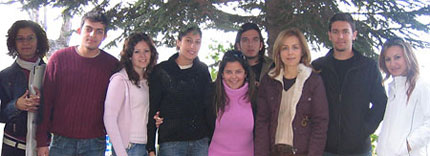 Plant Physiology class: Maya Farah (lab assistant), Khalil Khalil, Janet Kaprielian, Samar Shoueiry, Nadine Stambouli, Simon Khoury, Dr. Sima Tokajian, Mazen Rizk and Ghina Al-Haj.
Plant Physiology class: Maya Farah (lab assistant), Khalil Khalil, Janet Kaprielian, Samar Shoueiry, Nadine Stambouli, Simon Khoury, Dr. Sima Tokajian, Mazen Rizk and Ghina Al-Haj.
The students now have first-hand experience in a technique that has wide commercial applications as it can produce numerous identical plants in a short time.
Plants produced through micropropagation are uniform in size and shape as they are genetically identical. They are almost guaranteed to be disease-free and can be produced year-round in highly controlled chemical and physical environments away from seasonal changes.
The technique is used around the world to mass-produce plants, flowers and vegetables. Dr. Tokajian hopes it will encourage students to pursue income-generating projects after they graduate.
More
 Find stories by date
 Subscribe to the RSS feed
Latest Stories
- Rethinking Late Ottoman Arts and Crafts from Beirut
- Patient Preferences Shape Dialysis Access Research
- How Three Beirut Emergencies Reshaped One Hospital Plan
- LAU and Melhem Holdings Formalize Partnership to Advance Medical Education
- The Institute for Environmental Studies and Research Discusses el-Qaa as a Model for Heritage and Sustainability
- LAU Launches the Region’s Most Advanced Robotic Surgery Program
- Choosing Treatments for Multiple Sclerosis
- LAU Nursing Student Prepares to Bring Preventive Care to Rural Lebanon