
Syria’s refugees, five years into the crisis
LAU hosts international conference on the continuing refugee flow and its impact on countries neighbouring Syria.
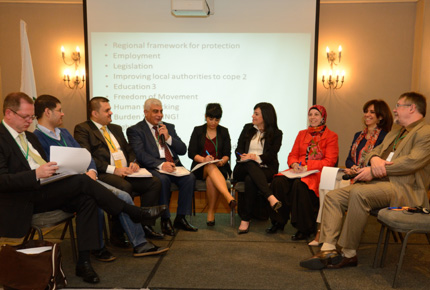
Speakers at the event came from Lebanon, Jordan, Syria, Kurdistan Regional Government, Turkey, and Germany along with UNRWA representatives.
The Syrian crisis is the biggest humanitarian emergency of our era, an ever-expanding tragedy that is harshly impacting the 3 million displaced Syrians as well as their host countries. In partnership with the Institute for Migration Studies and the Konrad Adenauer Foundation, LAU hosted last week a two-day conference that brought together regional and European experts to discuss sustainable ways of coping with the massive refugee flow.
LAU Professor of Political Science Sami Baroudi reviewed the Lebanese situation, citing a surge in unemployment, higher inflation rates and a negative economic growth as direct consequences of the Syrian crisis. On a political level, the situation has exacerbated long-standing divisions and raised security concerns as Lebanon seeks to insulate itself from the conflict next door. “The international community must live up to its promises and share the burden,” Baroudi said, voicing his hope that the imminent donor aid-pledging conference in Kuwait will yield sufficient funds to ease the strain on the country’s economy.
As the Syrian crisis enters its fifth year, speakers at the conference underlined the need to shift from a humanitarian approach to a more sustainable one, involving the launch of livelihood programs that empower the displaced and take advantage of their productive capabilities. The Turkish Migration and Politics Research Center’s Dr. Murat Erdogan noted that Turkey is developing a long-term strategy to deal with the 1.8 million Syrian refugees within its borders, based on the realization that these “guests” are there to stay.
Due to the precarious sectarian balance in Lebanon, that country’s approach to the crisis appears more hesitant, caught between the need for a labour-driven approach and the desire to prevent permanent resettlement. “The government is caught up in the political aspect of the crisis and cannot separate it from the humanitarian emergency”, said Dr. Paul Tabar, associate professor of sociology and anthropology at LAU who co-organized the event with colleague Dr. Jennifer Skulte-Ouaiss, assistant professor of political science. “This inability to take action is obliging the civil society to fill the void left by the institutions and endure the strain of the crisis,” he added.
Conference participants also shed light on the future of the 400,000 school-age Syrian children currently residing in Lebanon. This year has registered the lowest enrollment of Syrian children since the civil war began, a phenomenon that Dr. Maha Shuayb, director of the Centre for Lebanese Studies attributes to the impossibility for many of them to obtain official accreditation. The formal Lebanese education system — the only one to provide accreditation — has been impermeable to change, while the informal education system has readapted to facilitate the inclusion of Syrian students. “In Lebanon we acknowledge the French curriculum, we can even do a German baccalaureate, but the same does not apply to the Syrian education system”, said Shuayb.
While emphasizing their own commitment to helping the displaced Syrian population, speakers from Lebanon, Jordan, Syria, Kurdistan Regional Government, Turkey and Germany, as well as representatives from the UN Relief and Works Agency called for greater involvement from the international community.
More
 Find stories by date
 Subscribe to the RSS feed
Latest Stories
- Rethinking Late Ottoman Arts and Crafts from Beirut
- Patient Preferences Shape Dialysis Access Research
- How Three Beirut Emergencies Reshaped One Hospital Plan
- LAU and Melhem Holdings Formalize Partnership to Advance Medical Education
- The Institute for Environmental Studies and Research Discusses el-Qaa as a Model for Heritage and Sustainability
- LAU Launches the Region’s Most Advanced Robotic Surgery Program
- Choosing Treatments for Multiple Sclerosis
- LAU Nursing Student Prepares to Bring Preventive Care to Rural Lebanon